70 years of proven performance
STORY BY DALE SMITH
In today’s world, a product’s reputation can be built on the positive comments of a YouTube influencer. Of course, a company’s best efforts can be just as quickly whipped away.
Thankfully, in aviation – and avionics in particular – a product’s reputation isn’t built on some outsider’s opinion. It’s built in the cockpit and strengthened over thousands of hours of operation in the most demanding environments – in heat, weather, and vibration – while conducting missions that save lives in an EMS aircraft, fight fires, perform law enforcement functions, or haul the boss safely to their next appointment.
Avionics equipment either proves itself capable or it doesn’t. And if it doesn’t perform, it’s not around very long.
That fact alone makes Becker Avionics’ 70th anniversary something the entire industry should celebrate. Becker Avionics has built its reputation the quiet way: by making systems that do their job. No drama. No surprises. Just performance and reliability.
As Roland Becker, chairman of Becker Avionics Group explained, that single-minded philosophy can be traced back to Baden-Baden, Germany, in 1956, when his father, and company founder, Max Egon Becker, decided to take a step beyond his successful automotive radio business and into aviation communications.
The mid-1950s marked the beginning of a cautious but determined resurgence in German aviation, and his new company, Becker Flugfunk (aircraft radio), was one of the early contributors to that revival.
“The company’s first products were VHF radios, which were very simple by today’s standards, even by the standards of the time,” Becker said. “For example, the AR24 was introduced in the late 1950s and relied heavily on prewar technology. There were no major leaps in innovation, just the commitment to delivering a quality product.”
One of the company’s first meaningful opportunities came when Dornier GmbH introduced the Do 27. The single-engine, high-wing, short takeoff and landing aircraft was Germany’s first post-war, mass-produced entry back into civil aviation.
And the new multimission utility aircraft featured Becker Flugfunk’s, really good at one thing, VHF communications radios.

Evolving while staying the same
As general aviation expanded through the 1960s, so did expectations for avionics. Systems needed to not only be functional, a derining aerospaci Avionics vu: well ah the tr but also smaller, lighter, and more reliable.
Becker’s line of avionics evolved alongside those demands. And like the rest of the avionics industry, the transition from vacuum tubes to transistors marked a huge turning point.
Two new products, in particular, led the company’s continued technological evolution. Becker Flugfunk’s AR 12 VHF Radio reduced power consumption and improved durability, while the slide-in AR10 VHF COM brought avionics into more standardized instrument formats, aligning with emerging cockpit integration trends.
“The next big advancement came in the early 1970s, when Becker introduced the AR3201 VHF radio. Compact, efficient, and modern for its time, it represented more than a product upgrade,” explained Luis Gonzalez, president of Becker Avionics, USA. “It reflected a shift in mindset: avionics were no longer standalone devices. They were part of a broader system.”
In the late 1970s, the company introduced its 2000-series systems, including VHF radios, VOR/ILS navigation systems, ADF, and audio panels, bringing small, rugged, and dependable units to Becker Avionics’ lineup.
“The 2000-series combined military-grade reliability with a compact, lightweight design. The product line included Class 1 and Class 2 VHF COM radios, VOR/ILS navigation with cross-pointer and marker beacon, and ADF, all available in compact single-block or remote-mounted DZUS configurations,” Gonzalez said. “Their rugged construction made the products ideal for the SWAP (size, weight, and power) conscious helicopter environment.
“For helicopter operators, the appeal was immediate. Weight mattered. Space mattered. Vibration resistance mattered even more. These qualities translated directly into increased operational value. It wasn’t long before OEMs, including MBB (an early predecessor to Airbus Helicopters), selected Becker equipment for the BO 105 and PAH military helicopters. In the U.S., Petroleum Helicopters ordered the radios for their fleet.”


By the time globalization became a defining trend in aerospace, Becker Avionics was already well ahead of the trend.
Avionics from a pilot’s perspective
While the company was finding its technical footing, a second generation of Beckers was preparing to lead it. Roland Becker’s path into aviation didn’t begin in a boardroom. It began in the cockpit. By the time he was 17, while attending school in Switzerland, he became the country’s youngest certified pilot. By his early 20s, he had earned a commercial pilot license with multiengine qualifications. With a growing logbook, he looked at avionics and the roles they were to perform, not as products, but from the perspective of a qualified pilot.
After joining the family-led company in the 1970s, young Becker’s “pilot’s perspective” began to shape Becker Avionics’ future in subtle but meaningful ways.
“Most significantly, my ongoing vision for the company was never to push to build the most complex system,” Becker said. “Instead, the emphasis remained on what pilots and operators needed to complete their mission. This was facilitated by a concerted effort to listen carefully to the pilots and crewmen who carried out the mission. Not the OEMs’ management or engineers – well-intended as they might be.”
That mindset continues to not only define the company’s products today but also its entire global business philosophy.
One of Becker’s more strategic decisions stemmed from recognizing that Germany alone was not a large enough aviation market to sustain long-term growth. So, the company looked toward international expansion earlier than many of its peers.
As Becker explained, the company’s manufacturing operations were established in Taiwan around 1970, leveraging the electronics industry’s efficiency. By the mid-1970s, Becker Avionics had entered the United States, gaining access to the world’s largest general aviation market.
“When Becker Avionics established its U.S. office, it supported our prime line of compact avionics that included communications radios, navigation systems, and transponders,” he said. “In addition, the new facility was instrumental in supporting our growing air traffic control base business.”
Becker Avionics’ ATC ground stations had been selected by the Federal Aviation Administration, as well as many other air navigation and traffic control service providers around the world.
Speaking of going global, right after the U.S. office was established, the company’s strategic international expansion included offices in France, Brazil and Poland. Today, Becker Avionics is active in the worldwide aviation market. Like with its product development, this wasn’t expansion for its own sake. It was deliberate positioning that brought the company’s array of specialized avionics products close to OEMs, close to operators, and, of the most strategic, long-term importance, close to emerging aviation markets.
By the time globalization became a defining trend in aerospace, Becker Avionics was already well ahead of the trend.

FAR LEFT: The Becker Avionics office
in the late 1960s may look a little
different but the company’s promise
has remained unchanged: “We work
hard every day to keep you safe.”
LEFT: Roland Becker (seated)
is pictured with his father,
Max Egon Becker, who founded
the company in 1956.
A single-minded approach to meeting multiple needs
In the early 1980s, the arrival of GPS changed the course of aviation. Navigation systems became more precise, more capable, and more complex. That desire for greater capability was again highlighted in the early 2000s, when avionics entered into the digital revolution, and the next generation of software-driven avionics, integrated systems, and new expectations for connectivity.
For many companies, these shifts required reinvention. But, as it had done so successfully in the past, Becker Avionics adapted, without abandoning its core identity.
But the avionics industry’s path toward total cockpit integration meant that rather than competing directly with large-scale integrated flight deck providers, the company directed its efforts on doing what it did best, which was developing: extremely capable, compact systems; ruggedized, integrated communication solutions; and equipment that brings extensive capabilities into constrained platforms.
As Gonzalez explained, in today’s avionics landscape, Becker Avionics occupies a space that is easy to overlook but difficult to replace.

“Our lightweight, highly reliable, small form-factor avionics are well suited for general aviation aircraft, helicopters, gliders, and experimental aircraft,” he said.
“We’ve also earned a favorable reputation within the special mission platform providers, including search and rescue, emergency medical services, firefighting, law enforcement, intelligence, surveillance, and reconnaissance, and even some space applications. Any applications where reliability is nonnegotiable are prime for Becker Avionics products.”
When you put all of the company’s core capabilities together; you end up with its current products, including the highly capable DVC S6100+ Compact digital communication system.
“It’s the first digital intercom system to be awarded an
ETSO (EASA) and an FAA TSO,” Gonzalez said. “It reflects how the company continues to evolve to meet modern cockpit requirements while staying true to its strengths.
“The DVCS 6100 has a 10,000-plus-hour MTBF (mean time between failures) and is standard aboard the United States Army’s Lakota light utility helicopter. Becker’s follow-on Digital Intercom, the AMU6500, incorporates all the clarity, mission-centric capabilities, and robustness of the DVCS, while adding state-of-the-art 3D audio and Bluetooth.”
“Aviation tends to celebrate major advances, new aircraft, propulsion systems, and flight technologies, ” Becker said. “But much of aviation’s safety and efficiency depends on something less visible: equipment that works exactly as expected, every time. That’s where Becker Avionics has built its legacy.”
One success at a time
In a market increasingly dominated by large integrated avionics suites, Becker Avionics’ continued relevance comes down to a few consistent principles:
- Compactness: Critical for helicopters and legacy autrames with limited panel space.
- Reliability: Systems designed for high uptime in demanding environments.
- Simplicity: Reduced training burden for pilots and maintainers.
- Modularity: Ease of retrofit and compatibility with mixed avionics architectures.
“These attributes are particularly valuable for operators managing aging fleets and those with mixed avionics configura-tions,” Gonzalez said. “Our products are also very popular with operators faced with cost-sensitive upgrade programs. It’s not a product strategy that generates headlines, but it is one that earns trust among our customers – and that’s what matters.
“Today, Becker is more than an avionics manufacturer; we’re a long-term partner for aircraft OEMs, MROs and avionics shops around the world. We provide responsive technical support, engineering assistance, FAA-certified repair services, certification expertise – everything we can do to help aircraft operators and maintainers keep their aircraft flying efficiently for decades.”
The more things change, the more Becker Avionics excels at staying the
While all sectors of aviation continue to evolve toward greater automation, integration, and digital complexity, the bottom-line fact is that the need for dependable subsystems isn’t going away.
If anything, it’s increasing.
The successful and safe completion of every mission is dependent on the integrity of the aircraft’s components, and communication systems remain mission-critical across every segment of aviation.
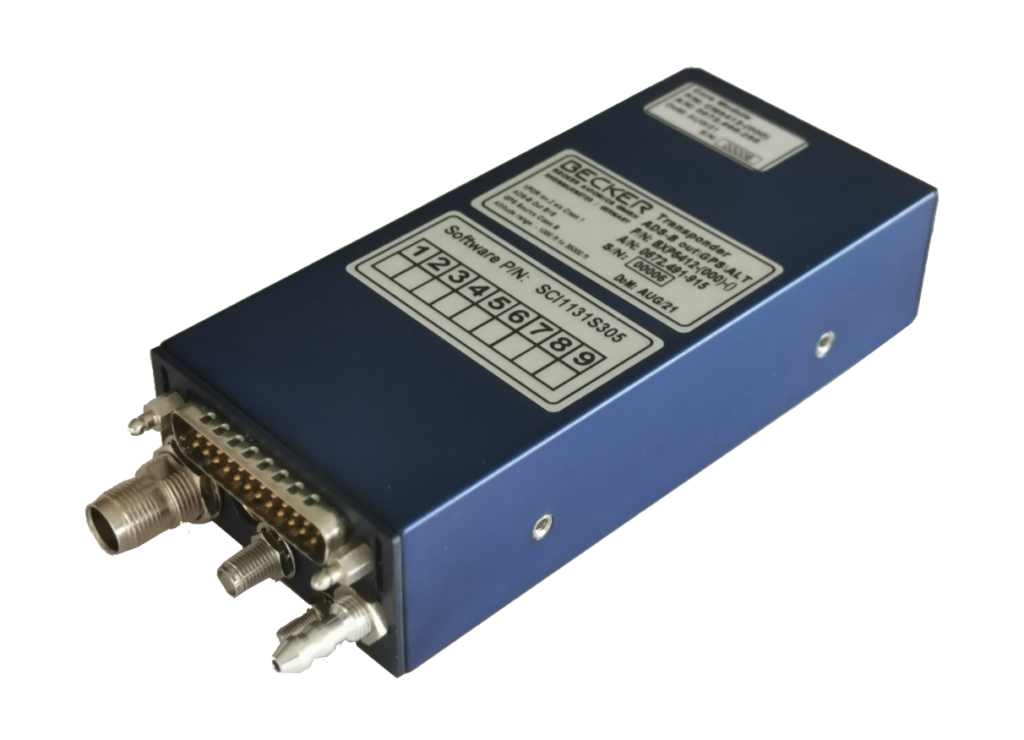
“Today, our top-selling products include our Mode S ADS-B transponders, VHF communication radios, and audio systems,” Gonzalez said. “Customers continue to choose Becker because of their reliability, compact design, ease of installation, and long service life, making them ideal for both new aircraft and retrofit applications.
“Becker is more than an avionics manufacturer; we’re a long-term partner: We provide responsive technical support, engineering assistance, FAA-certified repair services, certification expertise, and long-term product support, helping dealers and MROs keep aircraft flying efficiently for decades.” As for what the next 70 years at Becker Avionics may look like, Becker explained, “We are unlikely to redefine the cockpit but will continue to support it: quietly, reliably, and with the same philosophy that began in Baden-Baden, Germany, nearly 70 years ago. In aviation, that kind of consistency is more than a legacy. It’s an asset.”